

Fish hunter game rooms punish speed and reward patience, which is the opposite of what the interface suggests. The cannon fires the instant you hold the trigger, so nothing about the format feels like a decision. The actual decisions happen earlier: which room band you enter, which targets deserve expensive ammunition, and when a boss fight has stopped being worth the bullets already spent. This guide walks through the arcade section at AD88 exactly as a regular player would approach it, starting with the cost structure most newcomers never calculate.
What a fish hunter game room really costs per minute

Working out the cost per minute before entering a room changes almost every later decision.
Room bands and the real stake
Arcade lobbies in Bắn Cá AD88 are divided into three bands: beginner rooms with the cheapest ammunition, standard rooms carrying most of the traffic, and high-stake rooms built around boss hunting. The band sets the price of every bullet, and the bullet is the bet. A player firing 500 shots in a standard room has staked far more than someone firing 500 in a beginner room, even though both screens display identical fish. This is the most consequential choice in the entire format, and it is made before a single shot is fired.
Fire rate maths nobody calculates
A steady player releases 2 to 3 bullets per second. Across 10 minutes that is well beyond 1,000 bullets, so multiplying bullet price by 1,000 gives a realistic figure for a short session. Running that calculation once tends to move players down a band immediately, and the arcade lobby at AD88 makes switching bands free, so there is no cost to testing the lower option first.
Fish tiers and multiplier logic
Every creature carries a payout multiplier matched to its health pool. Small schools die in a few bullets and return a fraction of the stake. Mid tier targets absorb more and pay several times the bullet price. Boss creatures hold the largest multipliers alongside the largest health bars, so the payout broadly reflects the ammunition required to bring one down. A fish hunter game operates on expected value rather than luck alone, which is why chasing bosses on a thin balance rarely ends well.
Shared screens and the killing shot
Rooms are multiplayer, and several people are shooting the same target simultaneously. Only the killing bullet earns the payout. Every other bullet aimed at that fish is simply gone. Entering a boss fight late means paying full price for damage that other players already delivered.
Weapons and items that shift fish hunter game odds
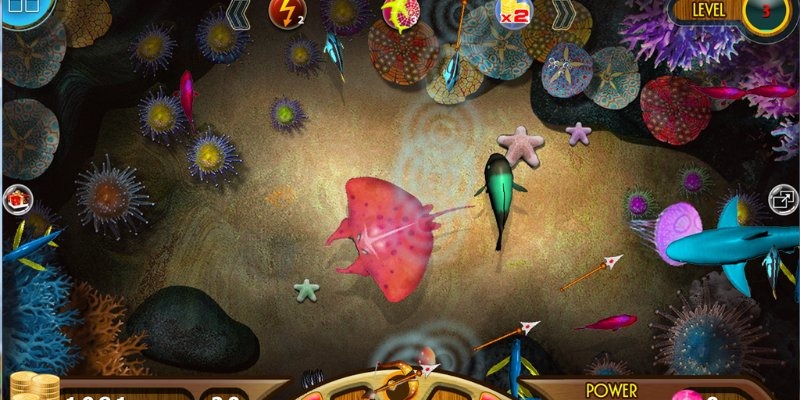
Weapon choice is the one genuinely controllable variable, so it deserves more attention than it usually gets.
- Standard cannon: the cheapest option and the correct default while you learn the spawn rhythm of an unfamiliar room.
- Laser cannon: concentrated damage at several times the price of an ordinary bullet, justified only near the end of a boss fight.
- Chain lightning: spreads across nearby targets and clears a dense school in one activation.
- Freeze bomb: halts movement briefly so that expensive shots land on stationary targets.
- Net or trap item: confines a group of mid tier fish while your cannon works through them steadily.
- Cost scaling: every item price rises with the room band, so the same freeze bomb can cost 5 times more one band higher.
Item timing matters more than item choice. Firing a freeze bomb the moment it recharges wastes most of its value, while holding it for a spawn wave converts it into genuine coverage. Players at AD88 who track what proportion of a session their special weapons consume usually revise their habits within a week, because the drain in a fish hunter game accumulates quietly rather than dramatically.
Budget rules for a longer fish hunter game run

Longevity in arcade shooting comes from spending rules, not from aim.
Split the budget into segments
Fix the session total, then divide it into 3 or 4 equal parts. When a segment is gone, pause and reassess the room instead of topping up on reflex. This single rule eliminates the most damaging pattern in the format, which is committing an entire balance to one boss that has already absorbed too much ammunition.
Apply the 300 bullet benchmark
A workable guideline: your session budget should cover at least 300 bullets in the room you choose. Below that figure, the band is too high and one poor sequence ends everything early. Dropping a band buys enough playing time for the underlying odds to express themselves, which is the entire purpose of a longer session.
Leave a boss fight when the maths says so
Boss encounters produce most of the losses in any fish hunter game because they feel like investments rather than expenses. When a boss has consumed a large share of your segment and other players have left the room, walking away is correct. The bullets already fired are gone either way, and staying only increases the total.
Log 10 sessions before concluding anything
Record stake, room band, duration and outcome across 10 sessions. Most players find their strongest results appear one band below the one they instinctively choose, and a written record shows that clearly where memory does not. Testing this inside the arcade section at AD88 costs nothing beyond the time it takes.
Conclusion
Fish hunter game results improve through choices made before the trigger is held: the band you enter, the items you time around spawn waves, and the budget segments you refuse to overspend. Learn how multipliers relate to health pools, treat every special weapon as a separate bet with its own return, and abandon boss fights that have stopped making sense. Applied steadily inside the arcade lobby at AD88, these habits turn a fast format into a manageable one. Set a fixed budget in advance and treat every session as entertainment spending.